Squarespace vs. Wix vs. Custom: What's Right for a Local Bradenton Business?
Website Fixes

The short answer: Squarespace runs $16-$99 a month and Wix runs $0-$159 a month on annual billing (Tooltester, 2026). Both are solid for a simple site with standard needs. A custom build costs more upfront but has no template ceiling. Which one's right depends less on the platform and more on what your business actually needs the site to do.
We get asked this constantly, usually by someone who already built a Squarespace or Wix site themselves and wants to know if they made a mistake. Most of the time, the honest answer is: not necessarily.
What Do Squarespace and Wix Actually Cost?
Squarespace's plans run $16 to $99 a month on annual billing (Basic, Core, Plus, Advanced). Wix offers a free plan with ads, then paid tiers from $17 up to $159 a month (Tooltester, 2026). At the low end, either platform is cheaper per month than almost any custom build. That's real, and it's exactly why they work well for a lot of small businesses.
Are Squarespace and Wix Actually That Different From Each Other?
Less than most comparison articles suggest. Wix holds about 45% of the global website builder market and Squarespace about 18%, but in the US specifically, Squarespace is actually the most popular, with GoDaddy Website Builder second and Wix third (SiteBuilderReport, 2026). Between them, they cover the large majority of small business template sites. If you're choosing between the two, you're choosing between two very similar tools, not a big tradeoff.
What Do You Actually Give Up With a Template Builder?
Both platforms build from shared templates, which means your site's layout options, however many there are, are also available to every other business using the same plan. Customization is real but bounded. You can change colors, swap sections, and edit copy, but the underlying structure of the page is the platform's, not yours. For a lot of small businesses, that's a fair trade for the price. For others, it's the exact thing holding the site back.
When Does a Custom-Built Site Actually Make Sense?
When your business needs something the template genuinely can't do well such as a booking flow specific to how you actually take appointments, a layout built around your actual services instead of a generic template section, or a site that needs to load fast and rank locally without fighting the platform's defaults. This is the same logic we covered in our post on website costs: the price difference is about scope, not about one option being universally "better." If you're not sure which side of that line your own site falls on, our full guide to knowing when your website needs a rebuild walks through the specific signs.
Frequently Asked Questions
Can I move from Squarespace or Wix to a custom site later without starting over?
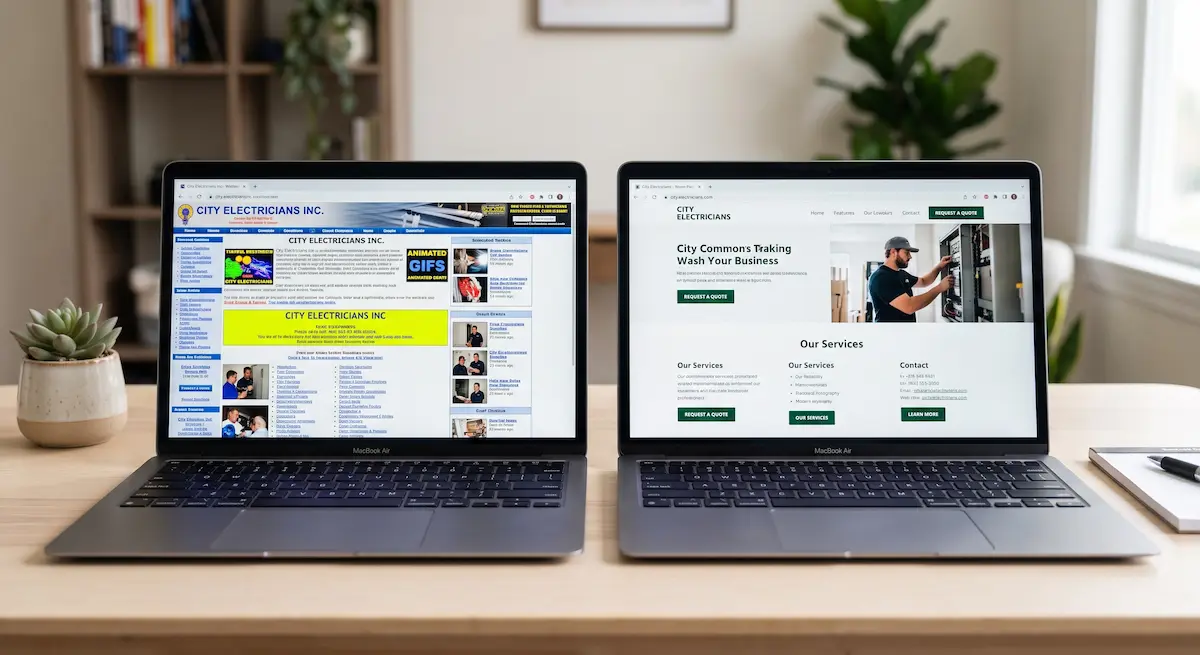
Yes. Your content, photos, and copy carry over. What changes is the underlying structure the site is built on, not the material itself. This side-by-side comparison breaks down exactly what changes and what doesn't, row by row.
Is Squarespace or Wix bad for local SEO?
Neither is inherently bad for local SEO. Both support the basics: mobile-friendly design, meta descriptions, and Google integrations. Where they can fall short is when a business needs something more specific than the template supports, which affects performance indirectly.
How do I know if I've hit my platform's ceiling?
If you're paying for workarounds, plugins, or a developer just to make the template do something it wasn't built for, that's usually the sign. A one-time custom build often costs less over time than ongoing patches.For the fuller list, see 7 signs your website needs a rebuild. Platform ceiling is just one of them.
Does switching platforms hurt my Google rankings?
Not if it's done carefully, with the same URLs preserved or properly redirected. The risk isn't the platform switch itself, it's an unplanned one.
Not Sure Which Option Fits Your Business?
Tell us what platform you're on now and what's frustrating about it. We'll give you a straight answer about whether it's worth keeping, updating, or replacing.
Get a Free Website Review →
Stay Inspired
Get fresh design insights, articles, and resources delivered straight to your inbox.